Opendoor vs. Real Estate Agent: Which Is Better in 2026?
-
 Research Team
 - 09 May, 2026
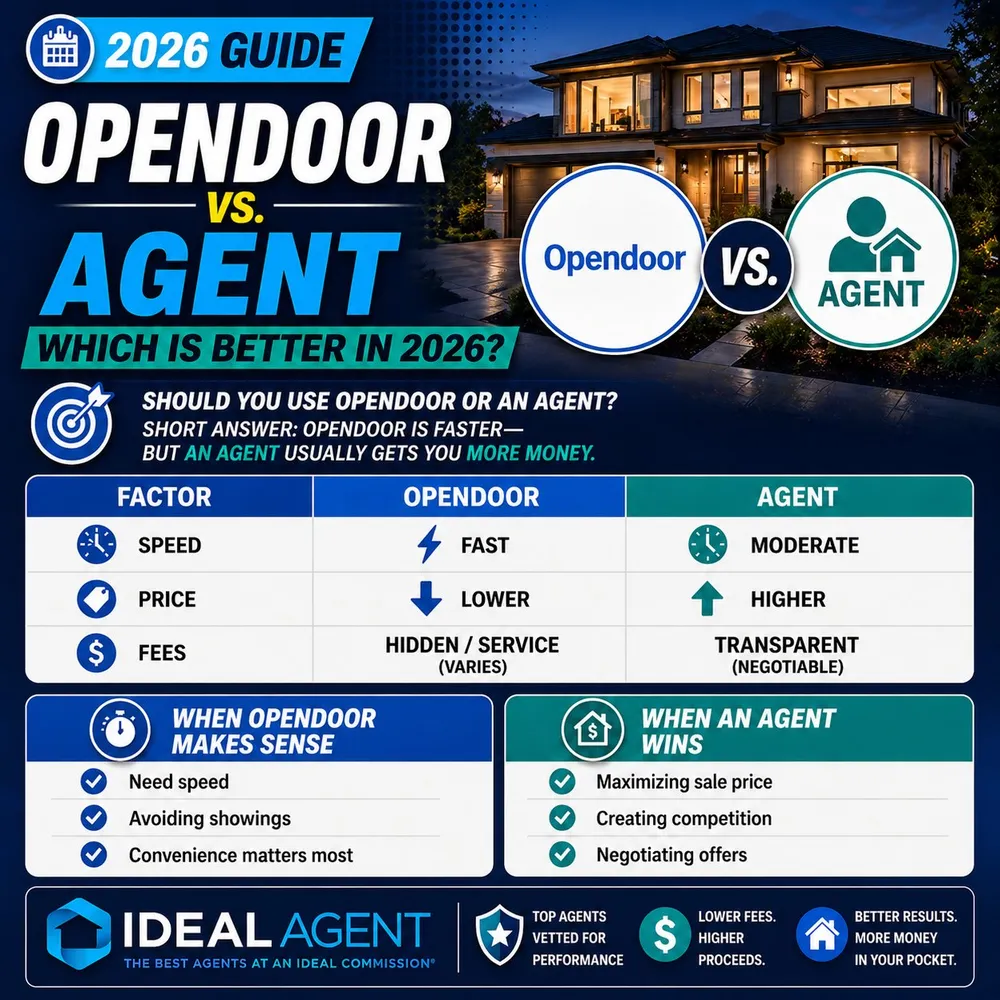
Opendoor made selling a house feel as simple as ordering a rideshare. Request an offer, skip the showings, choose your closing date. For sellers who value convenience above everything else, that pitch lands.
But simplicity has a price — and in real estate, it’s measured in tens of thousands of dollars. Here’s an honest, number-by-number comparison of selling to Opendoor versus listing with a realtor.
Should You Use Opendoor or a Real Estate Agent?
Short answer: Opendoor is faster and more convenient — but a realtor almost always gets you significantly more money. The decision comes down to how much your time and certainty are worth relative to the financial gap, which typically runs $30,000–$60,000 on a mid-priced home.
What Is Opendoor?
Opendoor is an iBuyer — a technology-driven company that uses algorithms to make instant cash offers on qualifying homes. You enter your address and basic details online, receive a preliminary offer within 24–48 hours, schedule an inspection, review final terms, and close on your timeline.
No showings. No open houses. No waiting for a buyer’s financing to clear. Just a fast, certain transaction.
The trade-off: Opendoor’s business model requires buying homes below market value and reselling at a profit. Their service fee (typically 5–8%) plus a below-market offer price means most sellers net significantly less than they would through a listed sale.
How Each Process Works
The Opendoor Process
- Request offer online — 24–48 hours to receive preliminary offer
- Schedule inspection — Opendoor assesses condition
- Receive final offer with fee breakdown and repair credits
- Accept and choose closing date (14–60 days out)
- Close and receive net proceeds
Total timeline: 3–6 weeks from request to funded sale
The Real Estate Agent Process
- Interview and hire agent — 1–3 days
- Prepare home (cleaning, staging, minor repairs) — 1–3 weeks
- Professional photography and listing launch — 3–5 days
- Active listing period — 7–30 days
- Negotiate and accept offer
- Inspection, appraisal, financing period — 30–45 days
- Close and receive net proceeds
Total timeline: 60–90 days from agent hire to funded sale
The Financial Comparison: What You Actually Net
This is the number that matters most. Let’s run it on a $400,000 home.
Selling to Opendoor
| Item | Amount |
|---|---|
| Estimated market value | $400,000 |
| Opendoor offer price (~90–93% of market) | $362,000 |
| Opendoor service fee (7%) | −$25,340 |
| Repair credits requested | −$5,000 |
| Estimated net proceeds | $331,660 |
Selling With a Real Estate Agent (IDEAL AGENT)
| Item | Amount |
|---|---|
| Sale price (open market) | $400,000 |
| Listing commission (2%) | −$8,000 |
| Buyer agent compensation (2.5%) | −$10,000 |
| Closing costs (2%) | −$8,000 |
| Estimated net proceeds | $374,000 |
Gap: $42,340 in favor of the realtor path — on the same $400,000 home.
That $42,340 is the cost of Opendoor’s convenience. For some sellers in specific circumstances, that’s a reasonable trade. For most sellers with 60–90 days and a move-in-ready home, it isn’t.
Key Differences Side by Side
| Factor | Opendoor | Real Esate Agent (IDEAL AGENT) |
|---|---|---|
| Speed | 3–6 weeks | 60–90 days |
| Sale price | Below market | At or above market |
| Service fee | 5–8% | 2% listing + 2.5% buyer agent |
| Repairs required | None (credits instead) | Sometimes minor |
| Showings | None | Multiple |
| Certainty | Very high | High (with qualified buyers) |
| Net proceeds | Significantly lower | Significantly higher |
| Negotiation | Minimal | Full expert representation |
| Best for | Speed above price | Maximum net proceeds |
What Opendoor’s Fees Actually Look Like
Sellers frequently underestimate the total cost of an Opendoor sale because the service fee is deducted from the already-below-market offer — not added to your home’s market value.
How the math actually stacks up:
- Opendoor offers 90–95% of their estimated market value
- Then charges 5–8% in service fees on top of that offer price
- Then requests repair credits after inspection (often $3,000–$8,000)
The net result is typically 80–87% of what the home would sell for on the open market. The gap between what Opendoor pays and what a listed sale produces is the profit margin that funds Opendoor’s business.
When Opendoor Actually Makes Sense
Despite the financial cost, Opendoor is the right choice in specific situations:
Hard deadlines you cannot move. Relocation for work, court-ordered sale timelines, or estate deadlines that make a 60–90 day traditional sale genuinely impossible. When speed is non-negotiable, Opendoor solves the problem that a realtor can’t.
Homes requiring significant repairs. Opendoor’s qualifying criteria are stricter than “we buy houses” companies — but they do buy homes that might otherwise be difficult to list traditionally. If your home needs $30,000 in repairs and you can’t fund them, an Opendoor offer (while lower) may be more practical than a traditional listing with all its condition-related complications.
Sellers who deeply value certainty. Some sellers — particularly those going through major life transitions — genuinely need the psychological certainty of a guaranteed close date and a known net number. For them, the financial cost may be worth the peace of mind.
Simultaneous purchase with tight timing. If you’re buying a new home and need your sale to close on a very specific date to fund the purchase, Opendoor’s flexible closing date is a meaningful advantage over a financed buyer whose timeline can shift.
When a Real Estate Agent Is Clearly the Better Choice
When maximizing net proceeds is the priority. If the difference is $30,000–$50,000+, most sellers are better served by a well-priced, well-marketed listed sale — even accounting for the additional time and effort.
When your home is in good condition. A move-in-ready home in a healthy market is exactly what creates competitive offers and sale prices above asking. Submitting that home to Opendoor’s algorithm instead of the open market forfeits all of that upside.
When you have 60–90 days. The traditional timeline isn’t as long as it feels. A well-prepared home can go from decision to funded sale in 60 days. The financial difference between Opendoor and a listed sale is worth that time for most sellers.
When your home has unique features Opendoor undervalues. Algorithms price homes based on data patterns. A recently renovated kitchen, exceptional lot, premium location within a neighborhood, or other qualitative features that buyers respond to emotionally may be undervalued by Opendoor’s AVM relative to what the open market would pay.
Getting an Opendoor Offer Without Committing
One smart strategy: request an Opendoor offer (it’s free and non-binding), then compare it to a CMA from a local agent.
This gives you two data points:
- Opendoor’s offer = the floor — the guaranteed, no-hassle number
- Agent’s CMA = the estimated market ceiling — what a listed sale could realistically achieve
The gap between those two numbers tells you how much the Opendoor convenience is actually costing you — and lets you make an informed decision with full information rather than guessing.
Frequently Asked Questions
How much less does Opendoor pay compared to market value?
Most sellers receive 80–87% of what their home would sell for on the open market through a traditionally listed sale, once the below-market offer price, service fees, and repair credits are all factored in. The exact gap varies by market, home condition, and the specific Opendoor offer.
Does Opendoor negotiate?
Rarely, and with limited upside. The business model is built on a formula. You may be able to push back slightly on repair credits, but significant price negotiation is uncommon. This is one of the starkest differences from the open market, where motivated buyers regularly compete and offer above asking.
Is Opendoor available in all markets?
No. Opendoor operates in approximately 50+ markets, primarily in Sun Belt and suburban areas. Rural properties, higher-end homes, and properties in markets Opendoor doesn’t cover don’t qualify.
Can I sell to Opendoor and list with a real estate agent at the same time?
You can request an Opendoor offer while simultaneously exploring a traditional listing. Requesting an offer is free and non-binding. Many sellers use this approach to establish a floor price before committing to a selling strategy.
What happened to other iBuyers?
The iBuyer market contracted significantly after 2021. Zillow Offers shut down after losing hundreds of millions. RedfinNow also exited. Opendoor remains the largest active iBuyer in 2026, though its volume is lower than the 2021 peak. The contraction reflects how difficult it is to algorithmically price homes at scale without taking significant losses.
Want to know what your home would sell for on the open market before deciding? IDEAL AGENT connects you with a top 1% local agent for a free, no-obligation valuation. Know your number — then decide.